> For the complete documentation index, see [llms.txt](https://docs.neuron-ai.dev/llms.txt). Markdown versions of documentation pages are available by appending `.md` to page URLs; this page is available as [Markdown](https://docs.neuron-ai.dev/neuron-v3-zh/dai-li/structured-output.md).
# 结构化输出
根据提供的 schema 强制约束 Agent 输出。
{% hint style="warning" %}
#### 编码代理技能
使用 **`/neuron-structured-output`** 用于教你的编码代理如何利用 Neuron 的能力,可靠地从 LLM 响应中提取结构化输出。
[AI 辅助开发](/neuron-v3-zh/gai-lan/agentic-development.md)
{% endhint %}
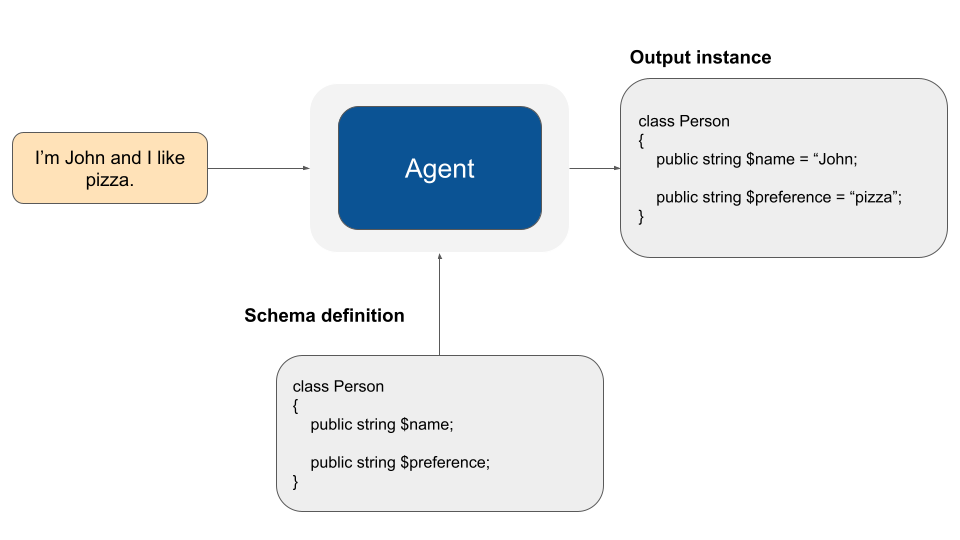
在许多场景中,我们需要 Agent 理解自然语言,但输出为 *结构化格式*。一个常见用例是从文本中提取数据,以插入数据库或供其他下游系统使用。本指南将介绍 Neuron 如何让你强制 Agent 输出结构化内容。
 {% embed url="" %}
### 如何使用结构化输出
核心概念是,LLM 响应的输出结构需要以某种方式进行表示。Neuron 所验证的 schema 由 PHP 类型提示定义。基本上,你需要定义一个具有严格类型属性的类:
```php
setThreadId('chat_id')
->structured(
new UserMessage("I'm John and I like pizza!"),
Person::class
);
echo $person->name.' 喜欢 '.$person->preference;
// John 喜欢 pizza
```
### 默认输出类
你也可以将输出格式封装到 Agent 的实现中,这样它就会成为该 Agent 的标准输出格式。你始终需要调用 `structured()` 方法来要求严格输出。
```php
use NeuronAI\Chat\Messages\UserMessage;
// 封装默认输出格式
class MyAgent extends Agent
{
...
protected function getOutputClass(): string
{
return Person::class;
}
}
// 如果你想获得结构化输出,请始终使用 structured 方法
$person = MyAgent::make()
->setThreadId('chat_id')
->structured(new UserMessage("I'm John and I like pizza"));
echo $person->name.' 喜欢 '.$person->preference;
// John 喜欢 pizza
```
### 控制输出生成
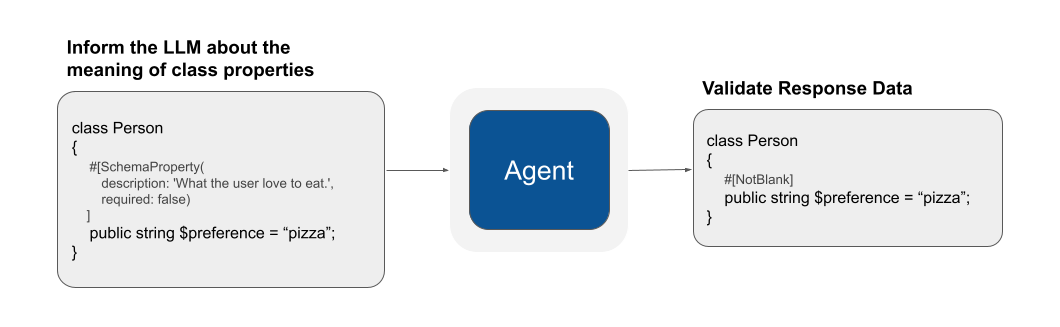
Neuron 要求你定义两层规则来创建结构化输出类。
第一层是 `SchemaProperty` 属性,它允许你控制发送给 LLM 的 JSON schema,以便其理解所需的数据格式。
第二层是验证。验证属性可确保从 LLM 响应中收集到的数据与你的要求一致。
 ### SchemaProperty
该 `SchemaProperty` 属性允许你定义每个属性的 JSON schema 参数:
```php
new SchemaProperty(
description: translate('invoice.customer_name'), // 获取翻译
required: true,
),
'total' => new SchemaProperty(
description: '总金额,货币单位为 '.config('billing.currency'), // 来自应用配置
min: 0,
),
];
}
}
```
解析规则:
* 在 `schemaProperties()` 中列出的属性会使用该 `SchemaProperty` 对象(它会 **替换** 该属性上的整个属性配置——两者不会逐字段合并)。
* 未列出的属性会回退到其 `#[SchemaProperty]` 属性(如果有的话)。
* 下游行为与属性完全一致,包括 `anyOf` ——因此你甚至可以动态构建多态数组的类列表,而 `反序列化器` 会正确地将其填充
### 嵌套类
你可以使用其他 PHP 对象作为属性类型来构建复杂的输出结构。沿用 `Person` 类的示例,我们可以添加 `address` 属性,并将其类型设为另一个结构化类。
```php
structured(
new UserMessage("I'm John and I want a pizza at st. James Street 00560!"),
Person::class
);
echo $person->name.' 喜欢 '.$person->preference.'. 地址:'.$person->address->street;
// John 喜欢 pizza。地址:st.James Street
```
## 数组
如果你将属性声明为数组,Neuron 会假定其中的项目列表是字符串列表。如果你希望数组包含其他结构化对象的列表,可以使用 `anyOf` 参数:
```php
structured(
messages: new UserMessage("I'm John and I like pizza!"),
class: Person::class,
maxRetries: 3
);
```
如果你使用能力较弱的 LLM,可以考虑设置一个重试次数,在获得有效答案的概率和潜在的 token 消耗之间取得平衡。
如果传入 0,就可以禁用重试。这将是一次性尝试:
```php
$person = MyAgent::make()->structured(
messages: new UserMessage("I'm John and I like pizza!"),
class: Person::class,
maxRetries: 0
);
```
## 监控与调试
你使用 Neuron 构建的许多应用都会包含多个步骤以及多次 LLM 调用。随着这些应用变得越来越复杂,能够检查你的代理系统内部究竟发生了什么变得至关重要。做到这一点的最佳方式是使用 [Inspector](https://inspector.dev/).
{% embed url="" %}
## 验证规则
由于 LLM 是非确定性系统,其输出的一致性会受到输入上下文质量的很大影响,而且它们仍可能产生幻觉,因此我们提供了一组验证规则,你可以将其添加到结构化类属性中,用来指示 Neuron 验证 LLM 生成的最终数据集。
如果一个或多个属性无效,验证规则允许 Neuron 多次将生成请求重新发送给 LLM,并附上详细报告说明哪里有问题,直到达到 [maxRetries](#max-retries) 值。
如果你没有定义任何验证规则,从 LLM 响应中提取的数据将直接填充到结构化输出类中。
### #\[NotBlank]
正在验证的属性不能为空。它接受 `allowNull` 标志,用于明确将 null 值视为空等价,或者不这样处理。
```php
namespace App\Neuron\Output;
use NeuronAI\StructuredOutput\Validation\Rules\NotBlank;
class Person
{
#[NotBlank(allowNull: false)]
public string $name;
}
```
### #\[Length]
判断一个 `字符串` 是否符合给定条件:
```php
namespace App\Neuron\Output;
use NeuronAI\StructuredOutput\Validation\Rules\Length;
class Person
{
#[Length(min: 1, max: 10)]
public string $name;
#[Length(exactly: 5)]
public string $zip_code;
}
```
### #\[WordsCount]
判断一个 `字符串` 是否符合给定条件:
```php
namespace App\Neuron\Output;
use NeuronAI\StructuredOutput\Validation\Rules\WordsCount;
class Person
{
#[WordsCount(exactly: 10)]
public string $title;
#[WordsCount(min: 1, max: 10)]
public string $content;
}
```
### #\[Count]
判断一个 `数组` 是否符合给定条件:
```php
namespace App\Neuron\Output;
use NeuronAI\StructuredOutput\Validation\Rules\Count;
class Person
{
#[Count(min: 1, max: 3)]
public array $dogs;
#[Count(exactly: 1)]
public array $children;
}
```
### #\[EqualTo] - #\[NotEqualTo]
这些规则具有相同的结构和含义,并接受一个参数来定义要比较的值。正在验证的属性必须严格等于(*#\[EqualTo]*)或不同于(*#\[NotEqualTo]*)参考值:
```php
namespace App\Neuron\Output;
use NeuronAI\StructuredOutput\Validation\Rules\EqualTo;
use NeuronAI\StructuredOutput\Validation\Rules\NotEqualTo;
class Person
{
#[EqualTo(reference: 'Rome')]
public string $city;
#[NotEqualTo(reference: '00502')]
public string $zip_code;
}
```
### #\[GreaterThan] - #\[GreaterThanEqual]
这些规则具有相同的结构和含义,并接受一个参数来定义要比较的值。正在验证的属性必须严格大于(*#\[GreaterThan]*)或等于(*#\[GreaterThanEqual]*)参考值:
```php
namespace App\Neuron\Output;
use NeuronAI\StructuredOutput\Validation\Rules\GreaterThan;
use NeuronAI\StructuredOutput\Validation\Rules\GreaterThanEqual;
class Person
{
#[GreaterThan(reference: 17)]
public int $age;
#[GreaterThanEqual(reference: 1)]
public int $cars;
}
```
### #\[LowerThan] - #\[LowerThanEqual]
这些规则具有相同的结构和含义,并接受一个参数来定义要比较的值。正在验证的属性必须严格小于(*#\[LowerThan]*)或等于(*#\[LowerThanEqual]*)参考值:
```php
namespace App\Neuron\Output;
use NeuronAI\StructuredOutput\Validation\Rules\LowerThan;
use NeuronAI\StructuredOutput\Validation\Rules\LowerThanEqual;
class Person
{
#[LowerThan(reference: 50)]
public int $age;
#[LowerThanEqual(reference: 1)]
public int $cars;
}
```
### #\[OutOfRange]
判断一个 `数字` 是否超出给定范围:
```php
namespace App\Neuron\Output;
use NeuronAI\StructuredOutput\Validation\Rules\InRange;
class Person
{
#[OutOfRange(min: 18, max: 35)]
public int $age;
// strict 参数强制严格保持在范围限制之外
#[OutOfRange(min: 48, max: 54, strict: true)]
public int $size;
}
```
### #\[IsFalse] - #\[IsTrue]
正在验证的属性必须恰好具有规则所定义的布尔值:
```php
namespace App\Neuron\Output;
use NeuronAI\StructuredOutput\Validation\Rules\IsFalse;
use NeuronAI\StructuredOutput\Validation\Rules\IsTrue;
class Phone
{
#[IsFalse]
public bool $iphone;
#[IsTrue]
public bool $refurbed;
}
```
### #\[IsNull] - #\[IsNotNull]
正在验证的属性必须符合规则定义的可空条件:
```php
namespace App\Neuron\Output;
use NeuronAI\StructuredOutput\Validation\Rules\IsNotNull;
use NeuronAI\StructuredOutput\Validation\Rules\IsNull;
class Phone
{
#[IsNotNull]
public string $brand;
#[IsNull]
public ?string $test;
}
```
### #\[Json]
正在验证的属性必须包含有效的 JSON 字符串:
```php
namespace App\Neuron\Output;
use NeuronAI\StructuredOutput\Validation\Rules\Json;
class Person
{
#[Json]
public string $address;
}
```
### #\[Url]
正在验证的属性必须包含有效的 URL:
```php
namespace App\Neuron\Output;
use NeuronAI\StructuredOutput\Validation\Rules\Url;
class Person
{
#[Url(schemes: ['http', 'https'])]
public string $website;
}
```
### #\[Email]
正在验证的属性必须包含有效的电子邮件地址:
```php
namespace App\Neuron\Output;
use NeuronAI\StructuredOutput\Validation\Rules\Email;
class Person
{
#[Email]
public string $email;
}
```
### #\[IpAddress]
正在验证的属性必须包含有效的 IP 地址:
```php
namespace App\Neuron\Output;
use NeuronAI\StructuredOutput\Validation\Rules\IpAddress;
class Person
{
#[IpAddress]
public string $ip;
}
```
### #\[ArrayOf]
正在验证的属性必须是一个包含所给对象类型全部元素的数组。注意,你还需要添加 doc-block,才能让代理实例化正确的类。在 doc-block 中使用完整的类命名空间。
```php
namespace App\Neuron\Output;
use NeuronAI\StructuredOutput\Validation\Rules\ArrayOf;
class Person
{
/**
* @var \App\Neuron\Output\Tag[]
*/
#[ArrayOf(Tag::class)]
public array $tags;
}
```
### #\[Regex]
正在验证的属性必须符合给定的正则表达式。
```php
namespace App\Neuron\Output;
use NeuronAI\StructuredOutput\Validation\Rules\Regex;
class Coupon
{
#[Regex('/^[A-Z]{2}\d{4}$/')]
public string $code;
}
```
## 自定义验证规则
验证规则是 PHP 属性,因此要创建新的规则,你应该继承框架的 AbstractValidationRule 并将该类标记为 PHP Attribute:
```php
namespace App\Neuron\Output;
use Attribute;
use NeuronAI\StructuredOutput\Validation\Rules\AbstractValidationRule;
#[Attribute(Attribute::TARGET_PROPERTY)]
class MyFormatRule extends AbstractValidationRule
{
public function __construct(protected string $format)
{
}
public function validate(string $name, mixed $value, array &$violations): void
{
if (!is_string($value)) {
$violations[] = $this->buildMessage($name, '{name} 必须是字符串。');
} else if (!$this->respectFormat($this->format, $value)) {
$violations[] = $this->buildMessage(
$name,
'{name} 必须匹配格式 {format}',
['format' => $this->pattern]
);
}
}
protected function respectFormat(string $value)
{
...
}
}
```
现在你可以在结构化输出类中使用该规则:
```php
namespace App\Neuron\Output;
class Route
{
#[MyFormatRule('apps/{id}/show')]
public string $path;
}
```